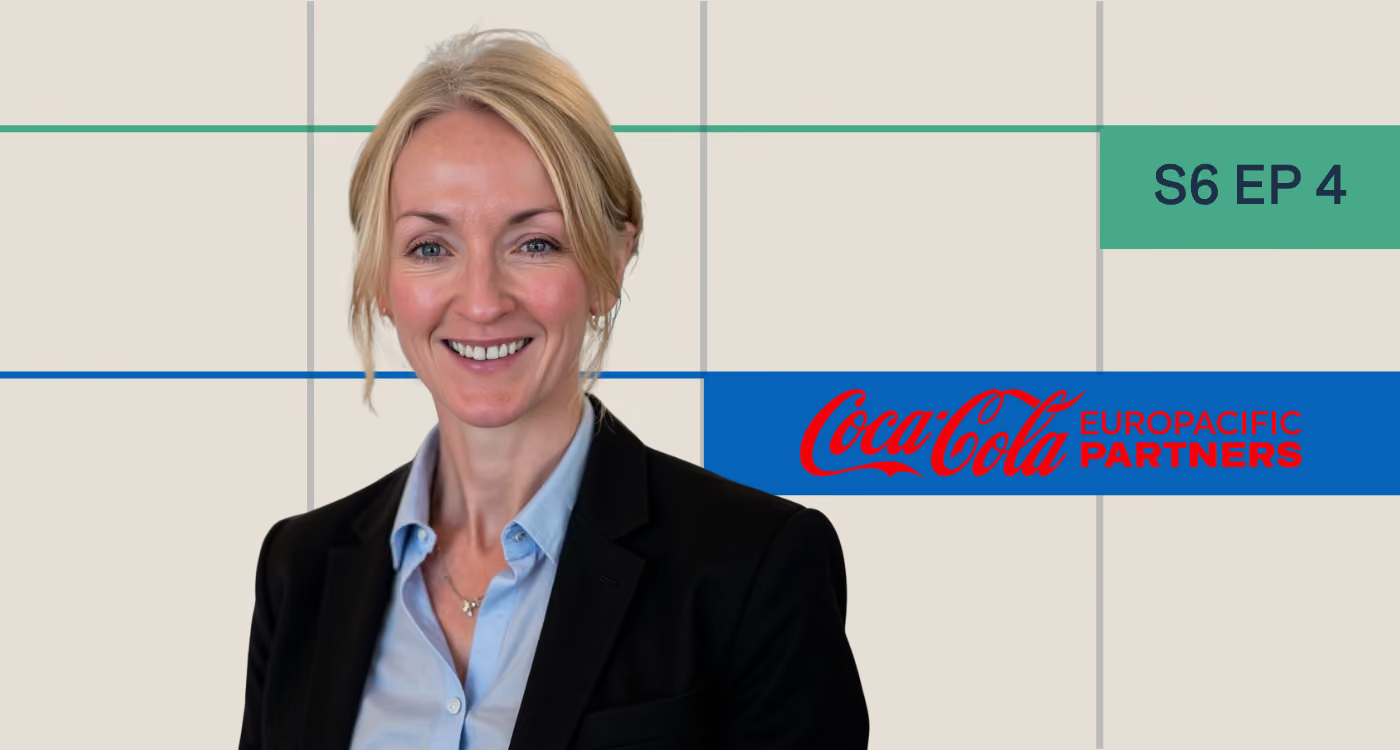
Introduction
There are very few brands in the world that can make a grown investor smile before you've even said a word. Coca-Cola is one of them.
As Head of IR and Corporate Strategy at Coca-Cola Europacific Partners, Sarah's job is to take one of the most beloved brands on the planet and turn it into a rigorous, credible, and compelling investment case. And she does it by staying closer to the business than almost any IRO you'll meet.
She visits the plants. She stocks the shelves. She photographs the in-store activations in Belgium and the Philippines and brings them straight into her investor meetings.
Having the world's most famous brand behind you may open the door. But it's what you do once you're in the room that matters. And in a company this complex, the investor story doesn't tell itself. That's Sarah's job. And in this episode, she tells us exactly how she does it.
Let's get into it.
Inside CCEP Investor Story
Mark Fasken: This is Winning IR, a podcast exploring the diverse insights within the IR community. Join me, Mark Fasken, as I sit down with IROs and other IR stakeholders to discuss the winning strategies, tactics, and shifts in thinking that are redefining the profession. There are very few brands in the world that can make a grown investor smile before you even said a word. Coca-Cola is one of them. As head of IR and corporate strategy at Coca-Cola Euro Pacific Partners, Sarah's job is to take one of the most beloved brands on the planet and turn it into a rigorous, credible, and compelling investment case, and she does it by staying closer to the business than most any IRO you'll meet.
Mark Fasken: She visits the plants. She stocks the shelves. She photographs the in-store activations in Belgium and the Philippines, then brings them straight into her investor meetings. Having the world's most famous brand behind you may open the door, but it's what you do once you're in the room that matters. And in a company that is complex, the investor story doesn't tell itself.
Mark Fasken: That's Sarah's job. In this episode, she tells us exactly how she does it. Let's get into it
Simplifying The Bottler Model
Mark Fasken: So Sarah, we were just having a little chat about the complexity of Coca-Cola and the bottling companies. And you're managing a portfolio that's actively moving into new categories. You've got alcoholic ready-to- drinks, enhanced hydration, energy drinks. We were just talking about sort of the impact of the war on supply chain.
Mark Fasken: There's a lot of moving parts. And so I'm curious, how do you build a credible investor story around a company that is complex and still evolving over time?
Sarah Willett: Sure. I mean, it might feel like it's complex, but the reality is soft drinks, in particular, which is the core of CCEP's business, is actually quite straightforward.
Sarah Willett: going back to the Coke system and how it works. We're the bottler, so we would be buying the magic syrup, so the concentrate from the Coca-Cola Company. That could be Fanta, it could be Sprite, it could obviously be Coke. Equally, we've got the Monster tie-up as well, so buying their concentrate.
Sarah Willett: But we bring that into our 90 factories, and we're doing effectively the same thing. We're adding the water, we're adding the fizz. We may not be adding fizz, by the way, 'cause we're also into still products like advanced hydration. Powerade's one of our big brands. Fuze Tea as well is our ready-to-drink tea brand. and then we're packaging it and selling it into customers, right? So, it might look like we're going into lots of new categories , but our core category is NARTD, as we refer to it. That's non-alcoholic ready to drink , so essentially soft drinks, but prepackaged. And then the way we articulate the story is, certainly for CCEP, we talk to NARTD within across our markets. We're in 31, by the way, across the world, and growing between 3 and 4% in revenue terms per year. And we expect to do a bit better than that, so we expect to be at the top end of that range. So we've guided to a midterm growth objective of- of around 4%. But then the way we articulate it is if you look under the bonnet, if you like, um, and we have a fact sheet on our website, like two pages, and it's very, very popular because it literally takes that 3 to 4% soft drinks and says, "Okay, show me how much sparkling's growing. Okay, that's growing low single digits. Call it maybe one, two."
Sarah Willett: Then you've got energy. Energy's growing low double digit. You know, there's lower penetration. Seems to be on fire right now. It has been for a few years. Everyone loves it, can't get enough of it. Ready-to-drink tea is, like, mid-single digit, and so on.
Sarah Willett: So when you average it all up, you know, the core category of soft drinks is that 3 to 4%. The one outlier, though, I think to your question, would be alcohol, alcoholic ready to drink, and that might seem like a really new category as well. But the reality is that the consumption of beverages is blurring.
Sarah Willett: It's not that people didn't used to have a Jack with a Coke. I mean, that's the thing, right? It's just that for different reasons, we think convenience has got a part to play. We think moderation's got a part to play with alcohol, and also affordability. So, alcoholic ready to drink is something that the Coke system started to get involved with a couple of years ago.
Sarah Willett: And what better way to do it? You take the best spirits brands and the best soft drinks mixers, and you put them in a can. And again, our business is quite simple. It's a slight difference in the production process ''cause you've also gotta add the alcohol. but you know, you take the Coke, you put the alcohol in, you add the water, you add the fizz, you add the pack, and you sell it.
Sarah Willett: It might feel like it's very, very different, but it's actually very complimentary to what we do every day.
Mark Fasken: And so you think about companies, I mean, it sounds simple to you. I-- For me, I think about the idea of running 30 factories that are bottling these products and bringing in all these different pieces and distributing it.
Mark Fasken: I think there is a level of complexity there for sure. And I think about other IROs or other companies that might be listening to this that are sort of in a similar space. Where you're expanding into new categories, you've got a portfolio of products, and maybe you're introducing new products. as an example, alcoholic ready-to-drinks or energy drinks are not a new product. But, you know, Monster was introduced years ago. That was a new product at the time. I guess my question is how do you balance as an IRO, how do you balance that stability story of like, we are a Coca-Cola bottler and we've been doing this for a long time, with that growth story of looking into the future and saying, "These are the products that we believe will contribute to growth over time"?
Innovation Packs And Channels
Sarah Willett: So if you stand back a minute, it's a great question, but if you stand back a minute, it's not just about new products. It depends how you look at innovation and growth, because growth comes from different angles. Some of it absolutely, like ARTD, alcoholic ready to drink, is new, so that's incremental to what I was talking to just now around soft drinks being our core.
Sarah Willett: Um, but then actually, there's been a lot of innovation and growth coming through from balancing what we call value for money or affordability. So, that's your large value packs, like a 24 can pack or your large PET packs, your traditional big packs with premiumization. we have what we call a very clear playbook around revenue and margin growth management.
Sarah Willett: And we're often referred to as best in class in this space. What we mean by that is we have a huge, huge pack offering, and a lot of packs have been introduced really since CCEP came about in 2016. So we've been developing this skill set. It can be occasion led, it can be channel led, it can be outlet led, but you'll find more and more people now want smaller packs.
Sarah Willett: Some of that is because actually one of the big trends in soft drinks is moderation. I still want to have my full sugar original Coca-Cola, but I don't want a large PET pack. So I wanna go for a nice little mini can. People can then access still our products through different pack sizes, but also glass is on the up as well. People like the traditional glass bottle.
Sarah Willett: If you go into Spain for example, very outdoors culture, most of what you can access in what we call the away from home channel. So when you're not actually consuming one of the products that you've acquired in a supermarket or a discounter and bringing it home for future consumption, you're out and about in a restaurant, cafe culture, et cetera, most packs in that channel in Spain will be in glass bottles.
Sarah Willett: And people believe, I believe it, that it tastes nicer in a bottle. but that's more in the premium end. And some of that has crept into the home space as well. so, if you go into a retailer, you can buy small glass bottles, and some larger glass bottles as well if you're having maybe a family special occasion at home and you want to have that experience.
Sarah Willett: So, um, it's the balance around how, how you drive innovation isn't just about new products and entering into complete new categories. There's actually a lot that's going on within the existing core ranges. also, flavor rotations are really popular.
Sarah Willett: Um, cherry is the number one flavor for colas in Europe, and this year we've basically relaunched a suite of cherry flavors. So, we've got cherry in Diet Coke, we've got cherry in Coke Zero, we've got cherry in Original Taste, and the new one is called Cherry Float.
Sarah Willett: It's a bit of a kick back to the '70s and '80s. Maybe you still do it today, Mark, but you know, you have a glass of Coke with a scoop of ice cream on it and a cherry on top, and it's basically taking all of those three flavors into one can. So it's basically vanilla, cherry, and Coke all in the same product.
Sarah Willett: So, um, it drives excitement. It feels like Okay, it's part of Coke And what they do. But actually some of these flavor rotations do stick over time and you actually make them a permanent listing. But it's all about driving, not just About the price point, it's not just about the pack, it's also about the consumer experience and how we as a bottler, together with the Coke Company can bring consumers together and make us something to talk about.
Mark Fasken: That's awesome. And when, when we talk about communicating- uh, there's like a smile on my face 'cause I'm thinking about all these Coke products, and a Coke float, which I do love. But when you talk to investors from an IR perspective, then you're talking about balancing sort of that growth story and there's different ways that you can drive margins.
Mark Fasken: It sounds though, again, like you've done a good job of taking what is, you know, there are a lot of products and there's a lot of packages and everything, and sort of taking that and simplifying it down to, you talked about your revenue and margin growth management story. Like, is that sort of the primary topic of conversation when talking with investors, and then it's saying, you know, we're really focused on revenue margins, and we're improving them in the following way. Product innovation, whether it's packaging or new flavors, or, or what have you.
Sarah Willett: Absolutely. No, 100%. And also about getting more customers in newer channels as well. So, we talk a lot about, you know, we're in every supermarket and every discounter, right? So that's a given. There's always an opportunity to get more displays and you know, more cooler space, 'cause whenever you see a Coca-Cola branded cooler or cold drink equipment, as we call them, they're actually owned by CCEP.
Sarah Willett: So we put them into market. We're effectively acquiring shelf space. There's always more of an opportunity to add more of those also into retail. But then there's also a big growth story around what we call away from home.
Sarah Willett: So more into hotels, restaurants, cafes, getting more of our products across the piece, across Coke, whether it's Fanta, Sprite, some of the innovation, and actually encouraging more listings in each of those outlets.
Sarah Willett: And there's a lot of custom wins going on right now, and we just talked a bit about some of those earlier this week with our Q1 trading update. It comes back to when you've got something to sell them across the piece, and it's taste for sure, but it's also fun and excitement and flavors. Flavors form part of that.
Sarah Willett: I think the addition of having more Monster in the portfolio is also attractive, and that's giving us a great opportunity. I mean, that category, as I said earlier, is on fire. We just posted on Tuesday this week volume growth of another 20%. That's on top of it last year growing nearly 20% as well. And that's really interesting.
Sarah Willett: You're seeing people are drinking this not just at nighttime or as a pick-me-up in the morning. They're having it across the day. Nearly half our customers, Mark, are actually female consumers consuming Monster now, even though it's in a really large can. Some of that's down to innovation. They're amazing at it.
Sarah Willett: But also some of it is because people are seeing it as a multi-occasion drink across the day. If you go into Burger King now, you can get it with a Whopper. You go into a Tesco's or you go into a Carrefour supermarket, you can get it as part of a meal deal.
Sarah Willett: So people are having it as part of a dinner, you know, a meal drink, some occasion drink, as opposed to it just being a one-off during the day. So yeah, I think we do a lot of events around, and in bringing some of this to investors. Fortunately, not too many.
Sarah Willett: We did a big capital markets event last year in the Philippines, and we actually showed them the markets, our newest market that we acquired a few years ago. But there's a lot of telling the story around the wider opportunity, whether by category, pack, so the revenue and margin growth management story piece, but also to new customer wins and how we're effectively out there peddling new customer wins every day.
Sarah Willett: And coolers have a big part to play in that. Last year was our first year of upping our cooler investments across our markets. I think in Europe we added another 70,000, and we've got a base of just over a million coolers, by the way. So that's quite a big number. But also in addition to that, we're doing it again this year, but we're doing it across Coke and Monster specific coolers as well.
Sarah Willett: So you'll see lots of Coke branded coolers, but you'll also increasingly see Monster branded coolers, and that's just because that category in its own right is getting big enough for us to be able to justify that investment.
Mark Fasken: Very cool.
Global IR And Brand Power
Mark Fasken: And so maybe shifting gears a little bit, we're talking about, the geographies that you are exposed to from an IR perspective. You are interacting with and managing investors with, you know, very different expectations in different locations, different cultures. How do you calibrate the message across sort of these different exchanges and these different investor types?
Sarah Willett: You can't start having different messages for different listings. I mean, essentially, most investors are global, so, you know, you might have a Lazard, for example. That would be a company that we would interact with in London. Equally, there'll be people dialing in from the US whenever we have any meetings with them, vice versa. From the US, people dialing in from London, time difference permitting, right? That's quite commonplace. I think the story, it has to be one message. It has to be consistently delivered.
Sarah Willett: And we are quite new in the FTSE 100. So we entered the FTSE just over a year ago, so March 2025. Up until that point, we'd very much been a US stock, so on the NASDAQ for some years, so the NASDAQ 100. Where it's different, is really just rooted in that event. So, because prior to being in the FTSE 100- Many of the investors that we tried to engage with in London in particular, even though they were interested in the story of CCEP, you know, are headquartered in the UK, it wasn't worth them spending time understanding anything about us because even if they liked the story, they couldn't own us 'cause we weren't in the benchmark.
Sarah Willett: So basically, the last year or so has been some very heavy lifting around having those very introductory conversations, which honestly you wouldn't expect to have. I understand you're not the brand owner. You're the bottler. You have, you know, 90 factories across 31 markets, and this is ... You know, they understand all of that and how the economic model works, works as well, and how the relationship works between the bottler and Atlanta and The Coca-Cola Company. But we've literally had to go back to the beginning and tell the story of Coca-Cola from the very start.
Sarah Willett: So been trying to do that in as many group forums as possible. And actually having that capital markets day when we expressly included some of that narrative was done deliberately because of that event. So for some people who are dialing in or, or actually there in person, that may have come across as, well, I know all of this, but actually they understood what we were trying to achieve.
Sarah Willett: We've done some dinners. We've done some lunches. You know, some of them I'm hosting. Some of them it's CEO, CFO, so, you know, we've definitely been in education mode, but that's starting to ... It's starting to land now, so actually we've seen a proportion of UK investors coming in, stepping up into, into the CCEP story, which is great.
Sarah Willett: I suppose beyond that, we've only just started doing it now we're a year in, is that I think the retail investor is quite different in the UK relative to the US. There's a lot more outreach, sort of local family offices, that sort of thing. There's a lot of private money uh, in the UK. It's something that I don't tend to get involved with too much myself. It's more my team doing some of that groundwork. But a lot of money is sitting in that space, which we could tap into 'cause the Coca-Cola brand is so powerful. You say Coca-Cola and normally, people will smile instantly, so it's helpful to have that sort of open door.
Mark Fasken: To your point, everybody knows Coca-Cola. I mean, whether you're a retail investor or an institutional investor, you know, it is an emotionally loaded brand. I mean, how many people have seen the holiday themed Coca-Cola commercials and, you know, all, all of these things, the polar bears. People sort of affiliate these things with like life events, which is always interesting. And so I'm curious, does that make IR in your opinion easier or more difficult?
Sarah Willett: I think easier in the sense of, you know, people know, who we are. But actually, it's interesting how, depending on your knowledge, how few of the wider brands are known.
Sarah Willett: So people tend to know Fanta, Sprite, Coca-Cola. They don't necessarily understand that Monster is sort of indirectly part of it as well. That Fuze Tea is a big brand. They may or may not know about the alcoholic ready-to-drink, and understandably that's quite new. The water brands also that we have, they don't necessarily know.
Sarah Willett: There's a lot that sort of sits under the umbrella. In fact, actually, I've been to the World of Coke a few times, the museum in Atlanta, and at the end you basically get a cup and you can go around and taste anything from anywhere in the whole of the world that's sold within the Coca-Cola branding, and I think there's 500 different brands or something like that. It's quite crazy.
Sarah Willett: I think the reality is it just makes it more fun in all honesty. I mean, there's lots of stuff going on this year as you can imagine. I mean, there's been a long-standing relationship between the Coke company and, FIFA, so with the World Cup coming, and particularly as it's in the US, there's a lot of excitement coming down the road.
Sarah Willett: We're about to start launching in the small and larger PET bottles. I don't know if you've ever been a fan of the football Panini cards, stickers. So you can collect them and they'll have your favorite footballers on, or you'll get a Coca-Cola branded book. if you, you know, can buy one of these things, and basically, you just excitement builds as you buy your next bottle of Coke and hoping that the behind the label is the sticker that you want. And if not, you know, I'm sure they'll be popping up on eBay and Instagram as people want to barter their way through to be able to get the mini stickers they want.
Sarah Willett: So there's some of that, for sure. I mean, Devil Wears Prada, the movie sequel, if you're into that, I mean, I think it's just about to launch in the next few days, if not today. Halloween's a massive event for, um, the likes of Chucky, and we had all of the s- Halloween horror characters on cans for Fanta last year. The year before it was Beetlejuice. You know, there's always fun stuff, and it's quite easy just to bring a smile to the conversations.
Sarah Willett: And then quite often when I'm in meetings, I mean, there's two things that I do. Number one, I spend a lot of time in markets actually making sure that I stay close to the business. I'm always taking photos, and I upload them into shared folders with my team so we can show examples of what we're talking about and what we've actually seen ourselves and experienced.
Sarah Willett: But equally, if I'm doing something like a sales meeting, I'm going in to talk to the sales traders at a bank in London, I'll take some samples in to get them to try Cherry Float or get them to try the new variant of Fanta.
Sarah Willett: And that always creates a bit of fun along the way.
Sarah Willett: So I would say, it's a great entry point. Coca-Cola is such a strong brand, but I think the reality is it just makes it more fun.
Mark Fasken: Absolutely. Totally agree. And so, I, I'm curious like, what, what you think is unique about the consumer space. sort of being at Coca-Cola, I mean, if you were to think about I'm gonna do IR in technology or industrials, what makes the consumer space really unique from an investor relations perspective?
Sarah Willett: I mean, it's unique in the sense that you're an FMCG, so you're a supplier into the industry. So, I mean On a personal level, I'm a very sort of tangible person. I've done IR for a long time, but I've either been in retail or in consumer. So you can touch the products. To me, that's really important , touch and feel.
Sarah Willett: Obviously in retail, you're one step forward. Actually now, I'm one step back, and I just get very excited about taking investors or analysts or even just going on my own.
Sarah Willett: I'll be going to a couple of plants over the next few weeks, one next week in Sydney. And the week after I'll be in Jakarta as well.
Sarah Willett: So, um, and you know, you see, you see the technology. mentioned technology companies, but technology in our space, there's so much technology, particularly in the plants and supply chain. Very few people. It's cans whizzing around, bottles whizzing around, and these lines are just getting faster and faster. You know, thousands and thousands of cans produced every minute.
Sarah Willett: So I think it's the tangible side of it, I would say relative to where it's not particularly technical in terms of understanding what we do. You know my analogy earlier. We take the concentrate, we add the water, we add the CO2, we add the pack, we sell into market. You know, it's a relatively straightforward process. It's not too technical in terms of explaining it. It is behind the scenes, right? I think beyond that, some of the terminology's a bit different.
Sarah Willett: So coming from a world of retail, it's more about like for like sales. You know, where I am, it's more about volumes and COGS per case and revenue per unit case and price mix and how that balances off. But you know, once you've got your head around them, it's relatively simple. And to be fair, the people that you're talking to, they're used to talking to not just you. There's lots and lots of other companies within the space like us that will be talking the same language, so they get it as well.
Mark Fasken: The other thing I would say is just an observation from me in speaking to you is that you seem to have a really good understanding as well of just the marketing and branding aspect of what CCEP is doing.
Mark Fasken: I mean, it's not often that I speak to an IRO that is referencing specific campaigns that their company is running. And so I think it's also cool that you obviously have a deep understanding of the bottling process and what that looks like, but also, like, how are we actually going to market with this portfolio of brands? Which I imagine is sort of unique to the consumer space and the tangible product. It's like, yes, we have this product, but how do we actually get it in front of people? Which I think is also part of the fun it seems like for you.
Mark Fasken: The other thing we've talked about a little bit is we talked about innovation and customer or consumer preferences. we talked about health, hydration. I mean, protein is a big one right now.
Strategy Role And IR Playbook
Mark Fasken: I'm curious, how do you get ahead of some of those trends in your investor communications rather than just being reactive to them?
Sarah Willett: I mean, I'm probably a little bit closer to the sort of strategy side, the longer-term conversations that are going on because I actually, I look after the investor relations and corporate strategy.
Sarah Willett: So at CCEP, what does that mean? Every other month, there'll be a wider PLC board meeting, and my team prepares his strategic update. And some of that is more stuff in flight and performance-based, but it's also about where we are with some of the long-term projects and some of the thinking around category trends, those sorts of areas.
Sarah Willett: But on that, we do a really big deep dive once a year. We have a strategy of a long-term five to 10-year, maybe three to five-year, depending on the topic, um, getting a lot of outside in. So we get people into the room to tell us, you know, what's going on with AI, what's happening with supply chain and what a supply chain's gonna look like in the future.
Sarah Willett: It can be lot, it can be lots and lots of topics. So I'm quite close to that because essentially my team's pulling all of that content together, and delivering that content for the board, and then I get to hear some of the conversations and participate in those conversations as well.
Sarah Willett: I think the reality is, you know, there's things like health and wellness and low or no sugar. I mean, these have been trends that have been around for a long, long time. They are accelerating, and who knows, some of that might be due to GLP-1, for example. But actually, health and wellness has always been an underlying trend that's been there for some time.
Sarah Willett: We have sugar taxes in most of our markets. We've embraced that. You know, it's actually encouraged the soft drinks industry to reformulate. And there's very little taste penalty these days. I know if you drink a Coke Zero or a Coke Original Taste, very few people can taste the difference.
Sarah Willett: And that's really important because you can have the same quality of taste but with no calories. And in fact, there's nothing in our portfolio that we have that doesn't have a low or no sugar alternative, and it's reflected in our volumes as well. About 50% of what we sell is low or no sugar. So that's been a trend that we've been very cognizant of, but it's actually accelerating. And that's something that, that we talk to investors quite a bit about.
Sarah Willett: I think areas like protein, they do look quite interesting. It's not always a lift and shift. A lot of these trends just tend to start in America and then move over. But some of them don't, honestly, Mark. I mean, a good example Would be in the alcohol space, hard seltzers, you know, Topo Chico would be the brand really for Coca-Cola.
Sarah Willett: And everyone's really excited about it. It's doing really well in the US. It came to Europe, and everyone was like, "Ooh, don't like this. It's like alcoholic water." And it sort of came in and came out quite quickly.
Sarah Willett: We're a very scaled operation. Scale matters to us in terms of our supply chain, so we've got to be careful about sort of following fads that may or may not land. But protein does look interesting. And that's something we're keeping a careful eye on.
Sarah Willett: Energy, as I mentioned earlier, was very small a few years ago. It's now much bigger, but it's still growing really, really quickly. And as I say, some of that is down to innovation. Some of it's just down to people drinking it more frequently as well, something we call distribution.
Sarah Willett: We effectively have category specialists for each of our categories. We as a company, particularly led by my side of the job relating to strategy, stay really close to what's going on with consumer and the trends out there.
Sarah Willett: But yeah, I think watch this space in protein. There could be something coming.
Mark Fasken: Ooh, exciting. You, you talked a little bit there about your team leading or having heavy participation in corporate strategy. How did that come about? And how does that impact the conversations that you are having with investors?
Mark Fasken: And the reason I ask this is that I think so many IR teams that we speak to, IROs we speak to, they want to expand their remit. They want to get more involved in strategy and more involved at the board level. And so I'm curious, how that happened with your team and the result in terms of how you're speaking to and interacting with investors?
Sarah Willett: Well, interesting question, 'Cause I'm not entirely sure how it happened. No, I must have been doing something right. Because as is often the case with IR standalone, the IR role tends to report into the CFO, okay? And I'd been in the role, I don't know, three, three, four years, then I got a phone call from my CFO saying, "Sarah, we're gonna give you corporate strategy, and there'll be a lot more interaction with the board. You've done a really good job. We think you can do it." And I was like, ""Okay."
Sarah Willett: Um, So as I say, I must have been doing something right. But in that vein, I've always wanted, throughout all the time that I've been doing investor relations, I've always wanted to sort of build my own suite of anecdotes and my own credibility in my own right, rather than just being the mouthpiece or the megaphone, if you like.
Sarah Willett: What's the phrase I normally say? IR's not just the megaphone but the microphone. And for you to be the microphone, you've gotta be out there, not just hearing and then regurgitating , if you like, or playing back what the CEO and CFO have said either in a meeting or in another context. But what can you bring to the conversation about things that you've seen and experienced?
Sarah Willett: So, myself and my team know that they have to do exactly the same, and they're very focused on doing that 'cause that's the way that we work. If ever we're in a market that's one of ours doing a roadshow or conference, we go and do a market visit, we go and see a plant.
Sarah Willett: We spend time with the local teams. I was in Belgium last week and I was seeing, for example, the new 007 activation in market of the relaunch of caffeine, practically it's Coca-Cola Zero , but caffeine-free. And it's in this new very, very sort of eye-catching black and gold packaging. Very well executed.
Sarah Willett: I know that when I'm having meetings with investors, I'm told this by the banks as well, by the way, that feedback's very positive around my team. We will get lots and lots of meetings , whereas other companies wouldn't necessarily get as many meetings for just IR because actually they know that we stay close to the business.
Sarah Willett: And in a good example as well, we'll be talking about cherry and all this launch of cherry flavors. I volunteered to go in and actually spend a couple of days actually merchandising and stocking shelves to see actually how much of this product was coming into shop floor and going into market.
Sarah Willett: And okay, I was slightly bribed by the fact that I was given a cherry hoodie off the back of it, but you know, I had so many things that I could then talk about and reference in meetings that, again, it adds to that credibility bucket that I have.
Sarah Willett: And I think the fact that I was doing a lot of that already and, you know, certainly the CEO and CFO could see it coming through the quality of the investor feedback probably contributed to them involving me when the opportunity came to get more involved in strategy itself.
Mark Fasken: Absolutely. Absolutely. So that's great. And I mean, so it sounds like just being in the business, like getting in the weeds to the extent of like stocking shelves and encouraging your team to do that is a big part of what's sort of differentiating you and the team.
Mark Fasken: It's like the stories that you tell. I think they're much more impactful. I mean, I think that that's a big thing, like I said, that I've noticed in our conversation is you have these very tangible stories and examples that you can give that are related to the business, which, you know, from a IR and storytelling perspective, it helps things land.
Mark Fasken: So this is our last question. You're pretty active in the IR community. Whether it's IR society or on panels, you know, peer networking. I'm just curious, what's something that you've picked up lately? Uh, whether it's inside of or, or outside of consumer goods from, from sort of another IRO that has changed the way that you work or sort of been a new addition or process or a tool that has been helpful for you?
Sarah Willett: I have been spending a bit more time in the IR community I'd say this year. Partly linked, Mark, in all honesty, it's partly linked to now being in the FTSE because actually reestablishing some of those networks I was more heavily involved with in my previous company which were FTSE listed.
Sarah Willett: So I've been sort of reengaging and reestablishing that this year. And I've always been keen to share as well, you know, I can help with the IR Society for example with some teaching events and sharing some of the journey that I've been on over the years in investor relations . And then I've agreed to be on a panel actually to your previous question around the IR-plus piece of my role. So at the IR Society conference this year in London, there's a panel actually about how IROs are engaging with boards. And I think, well, actually that's part of my job.
Sarah Willett: It's always good to hear what people are doing, particularly around the AI space. At the moment, it's really early days. I think, you know, depending on which tools you're allowed to use at work, I mean, our enterprise product of choice is Microsoft, unsurprisingly. We've all got 365 licenses, so we're using that to sentiment analyze some of our materials before they go out, try and take task out, make us more productive.
Sarah Willett: So we've been engaging in some of the events where others ... you know, there's been that conversation going on with some of our peers, whether it's in consumer or more widely. Don't think anyone's cracked it yet, so it's all a bit sort of everyone's learning. And you know, lots and lots of training going on. That's an area that I'm particularly keen to keep close to make sure that we're leveraging these tools. You know , a good example would be, we had an ESG webinar yesterday, because we've just updated our sustainability targets. And it's a really small example, but one of my team was like, "Oh, actually, I don't know ... I know we've had lots of, you know, sustainability conversations over the last couple of years, but we don't have them all in one place." We asked Copilot just to drag them out of our calendar , and it did it within seconds.
Sarah Willett: You know, that sort of thing that would've taken somebody in my team probably a couple of hours sort out. But then it meant that we could actually get the list together really quickly, and we ended up with a really long list of people that we were able to engage with. I think we had about 60 or 70 people on the call yesterday.
Sarah Willett: I think when you stand back and look at what you're trying to achieve, and it probably circles right back, Mark, to your first question about how you balance the growth story with all the excitement. It's about keeping your messages tight. The fewer the better. Don't make your slides too busy. Don't make your messaging too busy. If you ever see one of our releases, it's only ever four pages, and it's got lots of pictures on it as well. So we're very sort of consumer through and through with all those marketing messages.
Sarah Willett: Keeping close to the business and keeping that sort of evidence bucket so that you can bring it out, but do it in a fun way. And honestly, I think it makes you memorable. It makes you more credible as well with those relationships that you're fostering with investors and analysts. And then one of the phrases that one of our businesses use actually is in the Philippines on the U.S. Business. They use this phrase, and it's on all of their T-shirts, and it says, "Meet, beat, repeat. Meet, beat, repeat."
Sarah Willett: They always say the same thing. And I always think actually that's a really good way to, to think about investor relations as well. You know, meet, meet people lots, keep on beating the same drum around your key messages, and then just repeat the same messages through and through.
Mark Fasken: Awesome.
Mark Fasken: That's great. Well, Sarah, this has, this has been excellent. Really appreciate your time. Thank you.
Mark Fasken: I hope you enjoyed this episode of Winning IR, the investor relations podcast. Winning IR is brought to you by Irwin, the IR solution designed with engagement in mind. For more information and episodes, visit www.getirwin.com.