Introduction
If you’ve ever planned an international roadshow, you know the devil is in the details—and today’s guest has seen it all.
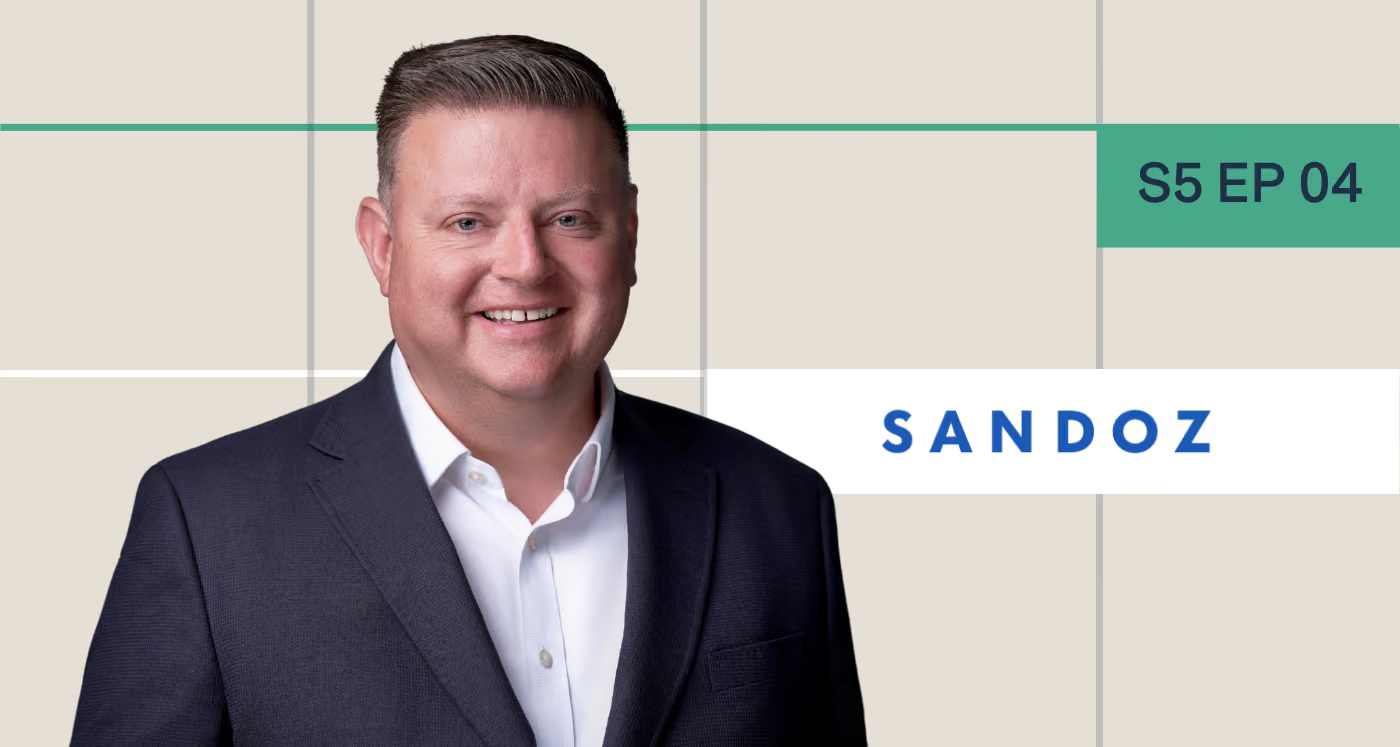
Craig Marks, now Head of Investor Relations at Sandoz, has spent over 20 years crisscrossing Europe, North America, and beyond, meeting investors in cities big and small. From Milan to Montreal, Basel to Baltimore, he’s turned every trip into a masterclass in making meetings actually matter.
Craig has learned the best roadshows aren’t built on luck or last-minute scrambling. They’re built on thoughtful planning, smart targeting, and a willingness to ask investors what they really care about.
Craig shares real-world lessons that don’t show up in the playbooks: the myths about investor engagement, the surprising shift away from ESG, and the practical tips that separate a forgettable roadshow from one your management team will actually thank you for.
Let’s get into it.
__________________________________
Introduction and guest background
[00:00:00] Mark Fasken: Thanks for joining, Craig. You spent a lot of time marketing companies to investors in all different markets — did a fair amount of international marketing, whether that's European companies or in North America.
[00:00:09] Mark Fasken: What's your approach to planning investor outreach in a different region, and what do you think IR teams often underestimate about international IR marketing?
Planning and preparation for international roadshows
[00:00:20] Craig Marks: I think the major thing is really just how much time it takes before, obviously during, but also afterwards, and follow-up is crucial.
[00:00:29] Craig Marks: If you think about the amount of time it takes, you got to be really clear about the steps you need to take. How much preparation goes into the targeting, making sure you're appointing the right broker or, if you're doing it yourself, the right platform, the amount of time you need to put into who you want to see at particular institutions, the format of each day, the travel logistics—it just takes a lot of prep time to get it done properly. And also, to make sure you are prepared not just in terms of Q&A, but the messages you want to get across.
[00:01:04] Craig Marks: For me, I spent a lot of time underestimating just the amount of prep required, but also really having a critical think about what you want to achieve out of a roadshow. What messages you want to get across, because you're not there just to answer questions. Most of the time, an investor can Google the answers; they want someone to be able to convey the story and to convey things they didn't know to ask.
[00:01:30] Craig Marks: I think some of the other things as well, for example, city-by-city planning. In Paris, you need to make sure there's at least half an hour between meetings because of traffic. In Frankfurt, they can walk between meetings, and they're a five- or ten-minute walk. I think spending time on logistics is really key. As well, making sure your group lunch is not in a public restaurant that's loud. Making sure you've got a private room organized. That you have no silver service. It's a buffet, so you don't get interrupted by [00:02:00] waiters, for example. A whole load of things to really think about.
Logistics and execution tips
[00:02:03] Craig Marks: I also think making sure you go back to those cities—there's no point in just doing one-offs.
[00:02:10] Craig Marks: If you have a good roadshow, make sure you go back and you select the amount of time gap. Sometimes you need to go and see investors every 12 months. If you've got a lot of news flow, you need to go back every six months. Making sure you go back, building out that local knowledge, making sure your notetaking actually is relevant.
[00:02:30] Craig Marks: One of the other things is, don't be snobbish about hedge funds. Hedge funds can be good for market insight, for information, for competitive information. You get to hear what other companies are saying. They provide liquidity.
[00:02:42] Craig Marks: I hear a lot of IROs talking down hedge funds, and I think in some cases that's absolutely warranted. In other cases, that's not warranted. I think there's a whole lot of things to consider when putting together a roadshow.
Targeting and engaging investors
[00:02:56] Mark Fasken: So, you talked a little bit about the amount of logistics that goes into it, choosing some of the right locations and restaurants. You talked a little bit about follow-up.
[00:03:03] Mark Fasken: When you're planning these multi-stop roadshows, are there other things, other steps that you take to make sure that roadshow is successful? Obviously, you can go on the road, you can have some meetings. That doesn't mean that they were good or that it was successful.
[00:03:17] Mark Fasken: So, what do you do to ensure that your CEO and CFO, whoever’s on the road with you, is saying "that was a great use of time?"
[00:03:33] Craig Marks: I think also, making sure you have access to the itinerary at all times. Whether you print it out and put it in your inside pocket, or whether you've got it on your phone, just making sure you've got it to hand. I think little things like that are really important because there's no assistant on the road with you. You are there to do all of those jobs and make sure you've got everything to hand.
[00:03:55] Craig Marks: As you're preparing, just make sure you've documented good standard operating procedures in terms of a checklist. So, when you appoint the broker, your policy around how much veto do you take from them? How much do you give to them? How much you offer them in terms of their ideas, how you bounce ideas off them. Making sure that, for example, if they're putting in meetings without you knowing off your target list, what do you do about that? I think policing the brokers is incredibly important.
[00:04:24] Craig Marks: Be really clear upfront as well. I used to call it the "big email." When you agree with a broker in principle that they will run a roadshow for you, send them just an all-encompassing email that lays out all your logistics around presentations, targets, logistics, flights. Making sure that if it's a London roadshow, they ensure there's at least 45 minutes between meetings. If you're going to, for example, Stockholm, all the investors come to you and you stay at the bank all day.
[00:04:52] Craig Marks: There are lots of steps you can do to make it successful, and also just be smart around your planning. If there's a conference going on in that town that week, making sure that you see the investors where you want to. I'll be doing a Toronto conference next year, and at the end of that week, or later on that week, I'll be visiting Montreal to mark up any Montreal investors we didn't go to that conference.
[00:05:14] Craig Marks: Really policing the brokers as well is absolutely key. Brokers do their best. Corporate access teams do their best for you. They're not there to make life difficult for you, but you really want to make sure that you're on top of it. You want to be able to chase the decline to find out exactly why those targets you put on the list, you're not getting those meetings.
[00:05:34] Craig Marks: What we do, and what I've done for a number of years — and I stole this idea off another IRO — is as soon as I provide the targets to a broker for a roadshow, we write to those targets and say, "Look, this broker should be getting into contact with you about this roadshow. If they don't, let us know. Give us a call, and we can arrange something." We usually get lots of investors coming back and saying, "I didn't get a call, I wasn't contacted by this [00:06:00] broker." So really police the brokers and make sure that they're sticking to your target list.
[00:06:06] Craig Marks: Spend a lot of time on targeting. It's one of the biggest processes and the biggest uses of time in investor relations. Making sure you go down to the level of where that person is. Are they based, for example, in Boston? Or are they based in Edinburgh? Who you want to see, which fund, and how you get maximum coverage then at that firm.
[00:06:27] Craig Marks: Putting out save-the-dates. Making sure you're really publicizing those roadshows, using some of the workflow tools in the CRMs that are available, as well as your website. Put your roadshows at the back of your results presentations and show where you're going to be.
[00:06:43] Craig Marks: You can base your roadshow off your targets, not your cities. So don't start off the year saying, "It'd be good to visit Dublin. It'd be good to visit Edinburgh." Actually have targets in mind. And then you work out the locations after that.
Regional differences and myths in investor relations
[00:06:55] Mark Fasken: Going off the back of the comment you just made about going and choosing different [geographies. As I said earlier, you've been all over. You've done New York, London, Zurich, Helsinki, Toronto, Montreal.
[00:07:04] Mark Fasken: I'm curious, where have you seen the strongest investor engagement, and where do you think IR teams are overlooking real opportunities? I think we all know that London is a great location. There's a lot of investors there, but are there other smaller markets that you think are a good opportunity for some companies?
[00:07:22] Craig Marks: Yeah, I think there are opportunities that some IROs overlook. For example, there are good investors in healthcare in Basel, in Geneva. Milan is a very good city to go to, and not so many IROs go to Milan. I'd suggest Lugano, and people don't tend to go to Lugano. Over the pond, I would definitely recommend at least once a year for IROs to do Toronto and Montreal. Certainly the West Coast. I'd include Denver in that, but Denver, LA, San Francisco. Mid-Atlantic: Baltimore and New Jersey. As well as getting into Texas. Philadelphia, Kansas City. Of all these opportunities, you can't do [00:08:00] them all. So again, prioritize, and that's according to your targeting.
[00:08:04] Craig Marks: In terms of where I've seen the strongest investor engagement, I don't think there's actually that much difference. I have to say, I think there are some myths in the IR world as to where you see the strongest levels of investor engagement. I think it's really a function of how much you put into it. How much you prepare, how much you plan, how much you engage, making sure you're really clear on what you want to achieve, the messages you want to get across.
[00:08:27] Mark Fasken: Speaking of myths, I think there's a little bit of a myth, or maybe a perception, that conversations with investors vary depending on the geography, right? If you're a U.S. company and you're going to go meet European investors, that's a different conversation than you have with investors in New York.
[00:08:44] Mark Fasken: I'm curious if that's been your experience. Have you found that those conversations are different in terms of expectations, the tone of the conversation, how those conversations are structured? Or do you find it's relatively the same across the different regions?
[00:08:58] Craig Marks: There used to be a difference. I've been doing investor relations now since, I guess it feels like the start of the Jurassic period. So, for a number of years.
[00:09:06] Craig Marks: If you went to the U.S., they'd focus much more long-term. In Europe, they would focus more short term. Go to the U.S., more investors wear gilets and polo tops than in Europe. But nowadays, the tone and the expectations—I think that the differences have lessened. I think a lot of the conversations now are more strategic.
[00:09:26] Craig Marks: There's certainly converging of an ESG focus that I've noticed. There was never an ESG focus in the U.S. What there has been in Europe is definitely receding. There's less and less focus in Europe on ESG. So, actually, there's not so much. I think certainly in terms of the U.S., a lot of investors can be more detailed. But that's quite a generalized observation. I think if you approach it on a reasonably similar basis, but just making sure you don't treat all investors the same. You don't just rock up to every single meeting and think this is going to be the same. Don't just rely on your investor profile you've turned out of a CRM. Really have a think about each investor, do your research, and actually, when you're in the meetings, ask them about their approach to investing. What is their focus? What is their slant? What are their priorities? Why have they decided to meet you? And really have a good conversation. You've got one mouth and two ears, so use your ears. Have a nice, engaging conversation and ask the investor about them and their approach. I think you'll get much better engagement out of those meetings.
[00:10:33] Mark Fasken: That's great.
ESG focus
[00:10:33] Mark Fasken: You talked about ESG a little bit, so we've touched on this next question. I know that in the NIRI circles over the years, there's been a fair amount of conversation about ESG. There's definitely been a perception that if you're going to Europe, you really need to be tight on your ESG story, and that's going to be a big topic of conversation. I just wanted to go back to what you said earlier. Am I correct in that your view is that is lessening? There is not as much focus on ESG as there once was?
[00:11:04] Craig Marks: I've worked in a number of different companies across a number of different sectors: retail, consumer, auto, healthcare, and so on. I'm sure it differs by sector and by company. So, I can only speak to my experience, which is limited. It used to be the case that you'd now and again get an ESG question in Europe, but I would just get nothing in the U.S. I still get no ESG questions in the U.S. I've been with Sandoz now since the start of 2025, and I haven't had one ESG question—in Europe, or anywhere else. Nothing.
[00:11:39] Craig Marks: We've thought about how do we market the very good ESG position we're in. We are looking to get more affordable medicines to more patients more quickly around the world. We're looking to improve access for patients where they don't have access to medicines. That should be a central part of an ESG story, but we just don't get those ESG questions.
[00:11:58] Craig Marks: It's really good to think about how much proactive effort we put into ESG materials. We don't engage in ESG conferences, we don't do ESG roadshows, we don't really have that much in terms of proactive IR materials, because we're not getting that interest. It'd be great if we did, because we've got a great position to talk about and a great ESG strategy, great ESG metrics, and I'm really proud of the work that the team at Sandoz does on ESG. But right now, we are not getting that interest from the buy side.
[00:12:32] Mark Fasken: That's interesting. You've dialed back the focus on ESG, and I want to switch gears here a little bit.
Final tips and podcast plug
[00:12:39] Mark Fasken: You've talked about tips that you would share with somebody who's thinking about planning an international roadshow, and we talked a lot about logistics and targeting and working with the brokers. If you had one piece of advice for an IRO who's planning their first roadshow, one mistake to avoid, or one thing that they really need to be focused on, what would it be?
[00:13:01] Craig Marks: One key one is making sure you build in time in your itinerary in a city for a private lunch for just your company. A lot of IROs will have a meeting, a group lunch. They may end up doing it in a public restaurant, at a noisy table where people can't hear. It doesn't work. And eating and talking at the same time can get quite messy.
[00:13:23] Craig Marks: I remember many years ago, when I started out in IR, we ended up in Frankfurt at the Opera House, where I was promised the best Wiener Schnitzel in Germany. I ended up talking a lot. Everyone else really enjoyed their schnitzel, and I think I had two bites. Make sure you have a private lunch; you have time for management to recuperate.
[00:13:44] Craig Marks: There are other things as well. So, making sure you're not trying to pack in too many meetings in a day. You just become unproductive. If you're tired, you end up repeating what you said. You end up repeating what management just said. You will forget that last question. You'll be drifting. Don't try and pack in too much. I would just do Tuesdays, Wednesdays, Thursdays. I wouldn't really look at Mondays or Fridays. Don't do two-week roadshows. I've done two-week roadshows before across North America, and that's a killer. Your voice goes. So, I wouldn't do that.
[00:14:16] Craig Marks: The one piece of advice, more than anything else, is just focus on quality rather than quantity. Making sure you're having five or six, maximum, good meetings in a day. You're fully prepared for them. You've really tailored your approach to each one. You know exactly what you are doing in those meetings with the messages you want to get across. Make sure management are briefed. If you send them the profiles and send them the itinerary the week before, they're not going to have time to read that in advance. Make sure you know what you're going to say to management in the car two minutes before the next meeting. Have that one- or two-minute explanation as to what you want to get across in the meeting, who they should be directing their eyes to, and their focus to in the meeting.
[00:15:01] Mark Fasken: I think those are great. You just take such a practical approach to these things, I think it's super helpful. At the end of the day, I think what I take away from your points is: there's no magic, there's no silver bullet necessarily. It really is just a lot of thoughtful planning and making sure that you're really focused on making the most of the time and that you understand who you're meeting, and you've got the story down and everything. I think having that checklist is really helpful for all of our listeners.
[00:15:26] Mark Fasken: Before we let you go, this is the first time I've interviewed a fellow podcast host. You've got a podcast of your own, which is just a fun side project.
[00:15:36] Mark Fasken: Did you want to give it a quick plug? What can listeners expect from Two Fellas, One Brain Cell this season?
[00:15:42] Craig Marks: Yeah. Thanks for the plug. I do appreciate it. But yeah, Two Fellas, One Brain Cell. It's me and my mate Steve. We record it in the pub, and we talk about really the most important things in life. IKEA, we've done crisps, we've done bands, curry houses, pubs. I think the next one is going to be about the worst things about traveling, which is clearly people who don't put their trays back after security. Those people just need to be rounded up.
[00:16:11] Craig Marks: Two Fellas, One Brain Cell, wherever you get your terrible podcasts. But thanks for the plug.
[00:16:15] Mark Fasken: Love it. Thanks so much, Craig. Really appreciate the time.
[00:16:18] Craig Marks: Good stuff. Thanks.
.avif)