Effective investor relations extends far beyond crafting compelling messages. How you deliver those messages carries equal weight in shaping how investors and analysts perceive your company. In a recent conversation on the Winning IR Podcast, David Calusdian, President at Sharon Merrill Advisors, explored how developing your presence and communication skills can transform IR effectiveness for both investor relations officers (IROs) and executives.
With over 30 years of experience advising clients through critical communications events ranging from IPOs to executive transitions and mergers and acquisitions, David brings invaluable expertise to the conversation. His insights reveal that successful IR communication requires a marriage of two essential elements: structured messaging and dynamic delivery.

The importance of structured messaging
Creating compelling messaging is crucial to investor relations, but it is equally important to ensure your message is persuasive and compelling. This matters because even the most carefully crafted investment thesis can fall flat without proper delivery.
David emphasizes two fundamental factors for verbal communication success. First, you must develop a very structured message. This means going back to basics and thinking through precisely what you are trying to communicate to your particular audience. Second, you need to master delivery through great body language and an effective voice.
"If you have an effective messaging structure that resonates with your particular audience and a dynamic delivery, you've got it all."
Before diving into delivery techniques, David stresses the critical foundation of message structure. Too often, professionals enter communications situations without a clear point, leading to meandering conversations that fail to resonate. For IROs working with IR decks, this lack of structure means the investment thesis may get lost entirely if it is not communicated throughout the presentation in a prescriptive, structured way.
The challenge intensifies in dynamic settings like investor meetings, where you cannot predict every question. This unpredictability makes preparation essential. Rather than attempting to memorize hundreds of potential questions and answers, David recommends identifying major topic areas where you might face challenges and developing key talking points for each. This approach allows you to respond dynamically while maintaining message discipline.
"You don't need to come up with a hundred different questions. I often see companies with Q&A documents that are a couple hundred questions long, and that's kind of self defeating. You can't memorize a hundred answers, but you can memorize key talking points to major topic areas that you may have trouble with."
The communications pyramid model
David uses a powerful framework adapted from McKinsey's pyramid principle, which he calls the communications pyramid. This simple yet brilliantly effective model works for delivering any message, particularly the persuasive speech central to investor relations where you are ultimately trying to convince investors and analysts of your investment story.
The pyramid contains three tiers. At the very top sits the theme, your main point. For example, when speaking to a slide on product development, your message might be that product innovation enables your company to capitalize on strong growth trends. The second level contains key messages that support that point, the messages you want your audience to remember as they leave the room. The third and lowest level includes the data, facts, figures, and statistics that back up each individual message.
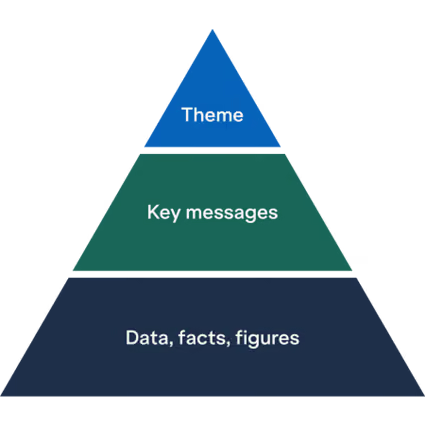
This structure enables the classic persuasive structure of previewing your message, delivering your message with supporting facts and data, and then reiterating or summarizing your message. By starting with your point, presenting supporting messages with backup data, and then returning to your main point, you hammer home your message three times with very structured, organized data supporting everything. This creates a truly persuasive argument, and helps your audience understand and remember your message.
The pyramid model also applies to question-and-answer sessions, though with an important modification. The top of the pyramid becomes your answer, and the middle contains supporting points. However, David recommends avoiding the bottom tier (those detailed facts and figures) during Q&A, because that is when people start to meander all over the place, mentioning a key message, then a fact, then jumping to a different key message and another fact until the response gets weedy.
"Where I find most people fall down on Q&A, is they just go on way too long."
Common mistakes in communication
The most common mistake David observes is that communicators lack structure in their messaging and fail to plan the main message they are trying to convey. Most people enter situations planning to talk about a topic without considering their persuasive argument or how they will support it. This results in meandering conversations without real points or supporting structure.
“If you're communicating through an IR deck, and you don't have an investment thesis, then the whole point of what you’re trying to convey may get lost.”
When you practice the pyramid approach consistently, you develop a mindset of being very crisp with three key messages for every question, keeping responses concise. This discipline transforms your effectiveness, particularly in the unpredictable environment of investor meetings where preparation meets opportunity.
The role of body language in communication
While message structure provides the foundation, delivery brings it to life. Without effective delivery, even the most well-thought-out messaging can get lost if the speaker is mumbling, rambling, or failing to convey enthusiasm for the topic. David emphasizes that you need both great body language and delivery alongside great messaging.
David focuses on three key areas of body language. First, posture helps convey confidence. Throwing your shoulders back and standing up straight may seem basic, but it remains critically important. You should talk and walk like you own the room and serve as the expert on whatever you are discussing.
Second, hand gestures present an area where many speakers feel uncertain. David receives constant questions about what to do with one’s hands, and his advice is refreshingly simple: keep it natural and use your hands as you would in normal conversation. Most people worry they use their hands too much, but David can count on one hand how many times he has needed to tell someone they are going too far with gestures. When necessary, he recommends keeping one’s hands within a strike zone between the chest and the belt, but otherwise, let them flow naturally.
"A good presentation is really a conversation. When you enter a speaking engagement, whether it's an investor meeting or a major speech, it should be a conversation. People want you to talk with them, not at them."
Third, eye contact creates engagement. Rather than scanning the room or fixing on a single point at the back, David suggests treating a presentation to 100 people not as one conversation with 100 people, but as 100 conversations with 100 people. Try to make eye contact with each person as best you can. This engagement also helps prevent audience members from constantly checking their phones.
Body language can reveal discomfort or uncertainty, even when your verbal messaging remains consistent. David shares a telling example of observing a CEO discussing his multi-industry company, which had six business units. The executive sat forward at the conference room table, very engaged and using hand gestures for the first five businesses. However, when asked about the sixth business, which was not performing well, he sat back, folded his arms, and maintained consistent language, but anyone trained in body language could notice the distinct change.
"We need to be cognizant of the things that create a perception of doubt when we're speaking."
Investors and analysts sometimes receive training from body language experts, making it essential to remain cognizant of signals you may be sending. Other problematic tells include hiding your hands behind your back or in your pockets (suggesting you are hiding something), covering your mouth when speaking (indicating discomfort with your words), and pointing your feet away from the audience (signalling you want to be elsewhere).
Executives often ask David about how to use podiums effectively during presentations. David discourages using podiums if avoidable, framing them as barriers between speakers and audiences. When standing behind a podium, one tends to grab it and look down at notes, breaking eye contact with the audience. He recommends walking in front of or next to the podium whenever possible, speaking from the heart and from memory rather than relying heavily on notes.
Improving executive communication
For IROs working to prepare executive teams, David offers practical guidance on common concerns. When preparing executives for presentations, earnings calls, or board meetings, IROs should look for several key elements. First, evaluate whether the message articulates the investment thesis. Whatever the format, whether an investor presentation deck or conference call script, it must communicate the investment thesis to your audience in a strong and compelling way. You should emphasize key takeaways over and over throughout the presentation, either implicitly or explicitly.
“What's the point of the conversation? If it's an investor presentation, does the deck hit the investment thesis? Whatever it is, is it hitting that investment thesis, are you getting your point across? Is it strong? Is it compelling? And do you have a number of key takeaways that you're emphasizing over and over again throughout the deck implicitly or explicitly?”
Second, assess energy and excitement in delivery. Many executives are not necessarily monotone, but they say things the same way throughout the entire presentation, providing no indication of what is important versus unimportant. If you say the word "excited" the same way you say every other word, it does not resonate. David recommends using vocal variety to make key points stand out. For every slide in a deck or major point in a conference call script, vary your delivery by talking faster to show excitement, softer for drama, or louder for emphasis.
Approaching executives who need help
Not every executive excels at public speaking, even when they possess deep business expertise. When approaching a management or executive team member who may not be a great presenter, several variables come into play. You must consider whether the management team is aware of their need for help, the relationship between you as the IRO and the manager, whether the team member seeks opportunities for self-improvement or tends toward defensiveness, and whether they genuinely want to improve.
David recommends approaching the entire team for media training rather than singling out individual team members. You can suggest that going through training would be a great exercise for everyone to up their game, emphasizing that even the best speakers go through speaker training regularly. The best speakers maintain their skills precisely because they invest in ongoing development. This team-based approach allows you to address individual needs without pointing anyone out directly.
"You may approach the team and say, ‘this is something we all should do’. I'm often brought into situations where there may be one or two members of management who really need help, but everybody goes through the training. So no one's singled out."
IROs may feel more comfortable providing constructive criticism when giving feedback on non-personal aspects of the presentation, such as the language. However, for areas like mumbling or other delivery challenges that may be sensitive for the speaker, bringing in an outside expert often proves more effective and less career-limiting for the IRO.
The importance of effective communication in investor relations
Ultimately, IROs and management teams should care about communication effectiveness rather than style alone. You must ensure you have the right message, that it is compelling enough to help achieve your IR goals, that it speaks specifically to your audience, and that it actually gets through to investors.
Without the right message for your audience, without the structure that helps it resonate and become more compelling, and without the ability to marry that good, structured, compelling message with effective delivery, your efforts will not contribute much. Success in investor relations communication requires a seamless integration of delivery and message, where each element complements the other to create maximum impact.
"If you don't have the ability to marry that good, structured, compelling message with an effective delivery that can help it get across to investors, then it's all for nothing."
These insights from David provide a roadmap for IROs and executives looking to elevate their communication effectiveness. By focusing on structured messaging through frameworks like the communications pyramid, mastering body language and delivery techniques, and approaching executive development thoughtfully, you can transform how investors and analysts perceive and engage with your investment story. The question is not whether you should invest in communication skills, but rather how quickly you can begin implementing these proven strategies to enhance your IR effectiveness.
.png)


%20(1).png)