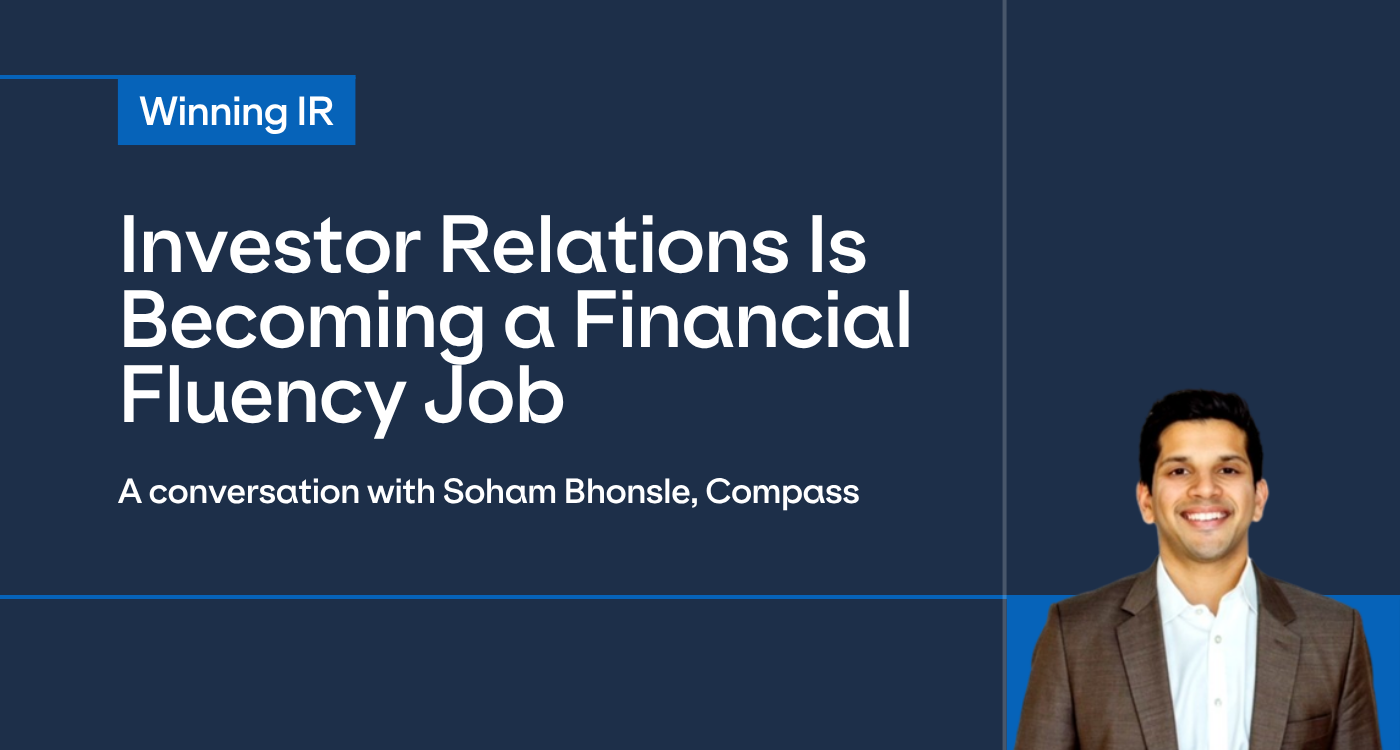
A few years ago, an IRO could get by on a great story and a well-rehearsed deck. That bar has moved. The investors calling you now are increasingly multi-strategy hedge funds who've built their own model of your business and want to talk about your P&L, not just your pitch.
Soham Bhonsle runs both Investor Relations and FP&A at Compass, the technology-powered real estate brokerage, a role he stepped into in October 2024 right as the company announced one of its largest acquisitions. Before that, he spent over a decade on the sell side covering the housing sector. He's watched the job change under him: "Maybe five to 10 years ago, the expectation or the role was more of a communications role," he says. Now it isn't.
Why he runs both functions at once
Bhonsle didn't end up running IR and FP&A by accident. He makes a specific case for why the two belong together: "When you're running FP&A, you're, by definition, forecasting the business. You're understanding where the business is going, what's working, what's not." That understanding, he says, "translates back really well into telling the story on the IR side, backed with numbers." The forecasting work and the storytelling work aren't two separate skills sitting next to each other. One produces the material the other one needs.
What it buys the investor, and what it buys you
The payoff isn't just credibility for its own sake. Bhonsle frames it around what it saves everyone's time: "I can give you the high-level view, but if you want to go down into the weeds, I can go into the weeds with you as well." And because he can answer at that depth himself, his management team doesn't have to be pulled into every meeting. "Our management team is very busy running the business," he says. "I'm always in the mindset of, how can I free them up and save them time." An investor who can get a real answer to a modeling question from IR directly has less reason to insist on the CFO's calendar.
What to do if you don't come from a finance background
Bhonsle is careful not to overstate his own experience, but his advice for IROs without a sell-side or accounting background is concrete: "Spend more time with your FP&A teams and understand the business." That means reading the releases and the financials closely enough to actually understand them, not just relay them. It also means rethinking where your time goes. As Bhonsle puts it, the instinct for a lot of IROs is to prioritize the narrative and the investor meetings above everything else. His suggestion is to put real time into the numbers work too, because that's increasingly what today's investors are showing up to test.
Why this episode is worth your time
The old split between "the numbers person" and "the story person" in IR is getting harder to justify. Bhonsle's argument is that fluency in the model is what lets you actually earn a seat at the table, because it's what frees your executives' time and what today's investors expect walking in. That same fluency was tested hardest when Compass bought the industry's second-largest player and the whole growth story had to change. Listen to his episode to hear how he and his team caught that the new narrative wasn't landing and how they reworked it in real time.
.png)

%20(1).png)